
Portsmouth City Directory Holdings
Portsmouth's strongest historical-directory collection is the Sargeant Memorial Collection at Norfolk Public Library, preserved with Portsmouth Public Library collaboration. Its digitized volumes generally combine alphabetical people and business listings, reverse streets, advertisements, and a business or local-government section. The Library of Virginia and Portsmouth's local-history room supply the deeper city-record shelf that helps test what a directory entry means.
| Collection | Years | Where Held | Access |
|---|---|---|---|
| Sargeant Memorial digitized Norfolk and Portsmouth directories | Catalog-visible runs from 1875–76 through 1931, with gaps | Norfolk Public Library ContentDM collection | Public browse and search; individual page details need visual checking. |
| Chataigne's Portsmouth directory item | 1882–83 | Sargeant Memorial ContentDM catalog | Catalogued digitized item; entry-layout details were not captured in research. |
| Portsmouth local-history books, documents, and microfilm | Varies by series | Esther M. Wilson Memorial Room, Portsmouth Public Library | Non-circulating local-history access; confirm current use rules. |
| Portsmouth city-record microfilm | Series-specific, including 1796–1950 ranges | Library of Virginia | Library/archives research using the listed microfilm series. |
Catalog visibility does not establish a continuous annual run. The visible directory listings omit or inconsistently display several years, including 1900 and 1901 in the text result. A separate 1900 Portsmouth title is digitized by Google Books, but the ContentDM collection remains the primary local partner source.
Portsmouth Digitized Directory Runs
The Sargeant Memorial digitized directory collection lists 1875–76, 1877–78, 1880–81, 1882–83, 1883–84, 1885, 1886, 1888, 1889, 1890–91, 1891–92, 1892–93, 1894, 1895–96, 1897, 1898, 1899, 1913, 1914, 1915, 1916, 1917, 1918, 1919, 1920–21, 1922, 1923, 1924, 1925, 1927, 1928, 1930, and 1931. The 1889 directory covers Norfolk, Portsmouth, and Berkley, so a search should check locality labels instead of assuming an entry is filed only under Portsmouth.
The digitized collection provides the online starting point for Portsmouth city directory research.
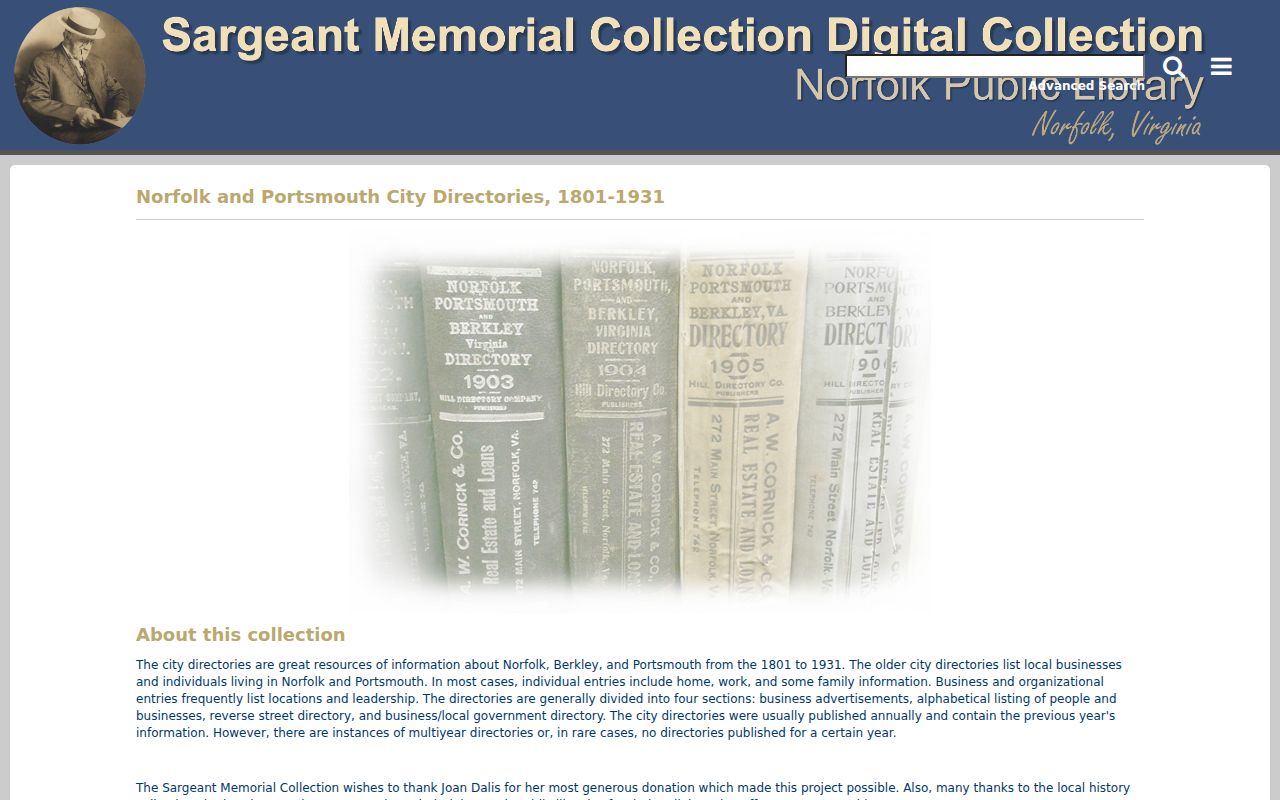
Compare the volume's own title, year, and page image rather than treating an OCR result as a complete transcription. The research did not verify whether every viewer search reaches interior-page OCR or only catalog metadata.
Portsmouth City Directory Entry Clues
A city directory entry is a dated publication clue, not an official finding of title or present residence. Start with the alphabetical listing, preserve the spelling exactly as printed, and capture the page with the volume year. The available research supports recording the following inventory only when the particular entry actually prints it:
| Name spelling | Use the exact surname, initials, suffixes, maiden-name form, or order shown in the volume. |
|---|---|
| Historical role | Record an occupation or business role only if the entry prints one, as a way to distinguish similar names. |
| Household wording | Preserve spouse or household wording if it appears; do not infer a relationship that the line does not state. |
| Street address | Copy the number and street as printed, including abbreviations, then compare it with the reverse section. |
| Volume reference | Keep the publication year and page so the entry can be checked again. |
- Alphabetical listing
- The name-ordered portion used when a surname or business name is known.
- Reverse street directory
- The street-ordered portion used to find the publication-year occupant or business from an address.
- Publication-year occupant clue
- Evidence that a person or business was listed at an address for that volume's year, not proof of ownership or current residence.
- Directory abbreviation
- A shortened form printed by a particular publisher; interpret it from that volume rather than importing a meaning from another directory.
Portsmouth Chataigne Directory Item
The collection includes an 1882–83 Chataigne's Portsmouth directory catalog item. Its metadata identifies the title, publisher family or title, and the 1880s period. The viewer did not expose individual scanned-page fields in the research, so it is a catalogued source, not a basis for claims about a particular printed symbol, street format, or interior-page search feature.
That limit is useful. Inspect the actual page before transcribing an address, a business entry, or an abbreviation. When a name crosses Norfolk, Portsmouth, and Berkley records, retain the volume's locality label beside the page citation.
Portsmouth City Directory by Street
When an old address comes first, open the reverse street directory before the alphabetical listings. Search the street name and number, copy the matching line, then look up the printed person or business name in the alphabetical portion. Repeat with nearby volume years to identify a move, a change in business name, a possible spelling difference, or a gap in the published trail.
A reverse line does not settle ownership. Pair it with an assessor parcel and a recorded deed if the question involves a property history. The November 1893 Portsmouth Sanborn set has 18 sheets and can help place an old directory line within a block, especially when a street context has changed.
Trace Portsmouth Households Through Years
Following a household through the Portsmouth city directory volumes works best as a dated sequence, not a single-name match. Portsmouth was a town from 1836 until city incorporation in 1858, and historical material may appear under Norfolk County, Portsmouth town, or Portsmouth City. Use the jurisdiction label printed or catalogued with each source.
- Find the earliest confirmed alphabetical entry, and save its exact spelling, address, year, and page.
- Check the next available directory year, noting a changed address, initials, business name, or household wording without assuming a missing year means a move.
- Use the reverse street section to confirm whether the address line points back to the same printed name or business.
- Pair the directory period with the appropriate census schedule and independent-city label, rather than assuming a Portsmouth County enumeration.
- Test a property connection through the Circuit Clerk's deed series, and use library microfilm, cemetery material, or chancery records for historical family context.
A disappearance can reflect a move, death, changed indexing, a missing volume, or an unlisted person. It is not enough to identify the reason without another record. This careful sequence is especially important for common surnames and for nineteenth-century Norfolk, Portsmouth, and Berkley crossover.
Portsmouth City Directory Library Shelf
The Esther M. Wilson Memorial Room was founded in 1963 after Mary J. McMurran persuaded Judge Benjamin Dey White to donate library material for a designated historical room. It holds non-circulating books, documents, and microfilm. The wider Portsmouth special-collections service identifies local history and genealogy material, cemetery links, and Portsmouth births covering 1853–1917.
Portsmouth Special Collections provides the local-history and genealogy routing for the library shelf.
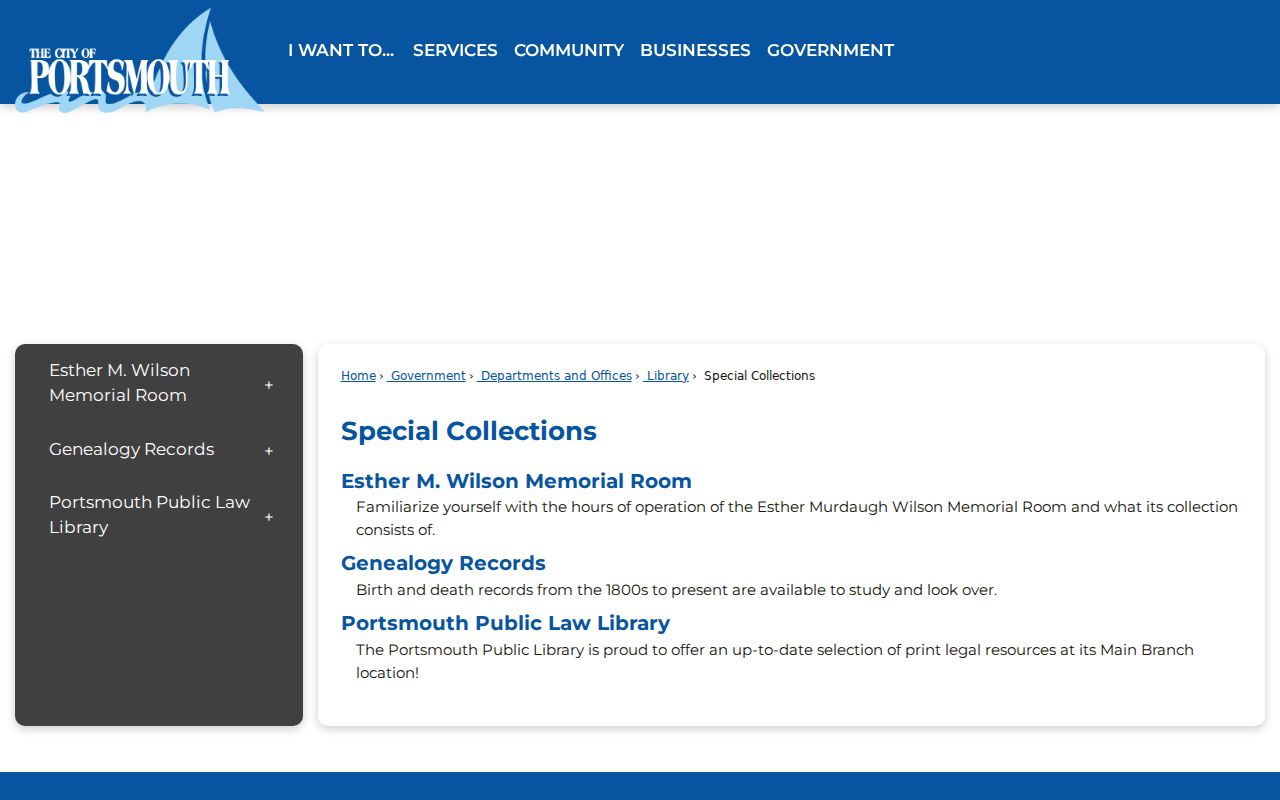
The Local History hours reported by the library are Tuesday and Wednesday, 10–4. Main Library is at 601 Court Street, Portsmouth, with telephone routing at (757) 393-8501. Card, in-library, and remote-login conditions for databases should be confirmed before a research visit.
The library's digital branch also identifies Ancestry for Virginians, HeritageQuest, Portsmouth vital-record material, and school yearbooks. Those resources can supply family or school context for a directory line, but the research does not establish that they give a complete or current address trail.
Portsmouth Directory Context on Microfilm
The Library of Virginia Portsmouth microfilm inventory provides exact series that turn a directory clue into local-record research. It lists town and city administrative records for 1796–1868; Hustings chancery for 1866–1874 and minute books for 1858–1869; Deed Books 1–4 from 1858–1869; the marriage index for 1858–1950; birth and death registers for 1858–1896; Circuit Will Book 1 for 1858–1913; and fiduciary, guardianship, audit, and inventory runs.
Library of Virginia microfilm coverage identifies the archival record series behind Portsmouth names and addresses.
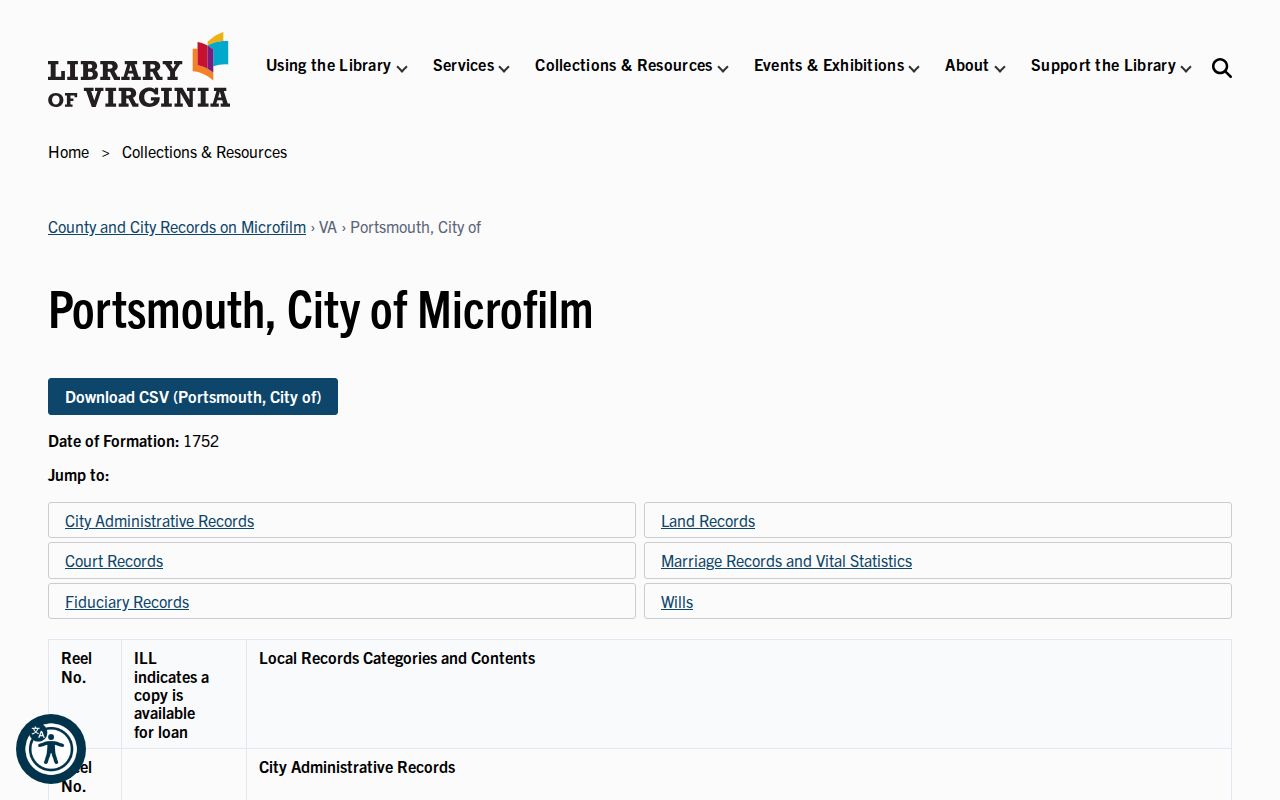
The Library of Virginia Chancery Index separately lists scanned Portsmouth City causes from 1859–1932, with most scanned material from 1859–1913 and originals for 1914–1951. Chancery records may add family names, land descriptions, exhibits, and signatures, but they are historical case material rather than a current-address index. Use the case year and locality together when comparing a cause with a directory volume.
Portsmouth City Directory Timeline
The directory shelf sits inside Portsmouth's change from town records to independent-city records. The timeline gives useful search labels without claiming a complete printed-directory history.
- 1836: Portsmouth was incorporated as a town.
- 1858: Portsmouth was incorporated as a city; the local deed-book series begins with the post-incorporation records.
- 1875–76: The first Portsmouth directory year visible in the documented ContentDM listing appears.
- 1882–83: The collection catalogs a Chataigne's Portsmouth directory item.
- 1893: The Library of Congress Portsmouth Sanborn set contains 18 November sheets for block and building context.
- 2014: A city-library digitization project reported 10,000 items scanned with Library of Virginia equipment and volunteer assistance.
The 2014 project is a useful collections lead, not a promise that every scan is online, searchable, or indexed. Likewise, the ContentDM listing's 1931 volume is the latest year visible in the documented listing, not proof that 1931 was Portsmouth's last printed directory. Library of Virginia identifies Norfolk County as extinct, which is why a historical catalog search should use the relevant town, city, or county-era label.
Portsmouth City Directory Limits
A historical directory can be a powerful family-history and address clue, but it does not prove title, present residence, or a complete household. A person can be absent because of a move, an indexing change, a missing volume, a spelling variant, or the publication's own coverage choices. An address can be abbreviated or later altered in context. Compare the printed page with an assessor parcel, a deed's legal description, a map, or a relevant archival record.
Library sources also have access limits. The special-collections pages do not expose a named obituary index with a verified date range, and the research did not confirm a standalone Portsmouth historical-society holding. Use the Wilson Room, city special collections, the Library of Virginia, and official historic materials until a collection confirms its exact holdings.
Research tip. Save the volume title, publication year, page, locality label, and exact spelling with every Portsmouth city directory finding. Those details make a later comparison possible.